
At no cost to you, Davey Mitigation evaluates your land for mitigation. Our scientists examine the property in careful detail to confirm it's a good candidate for restoration.
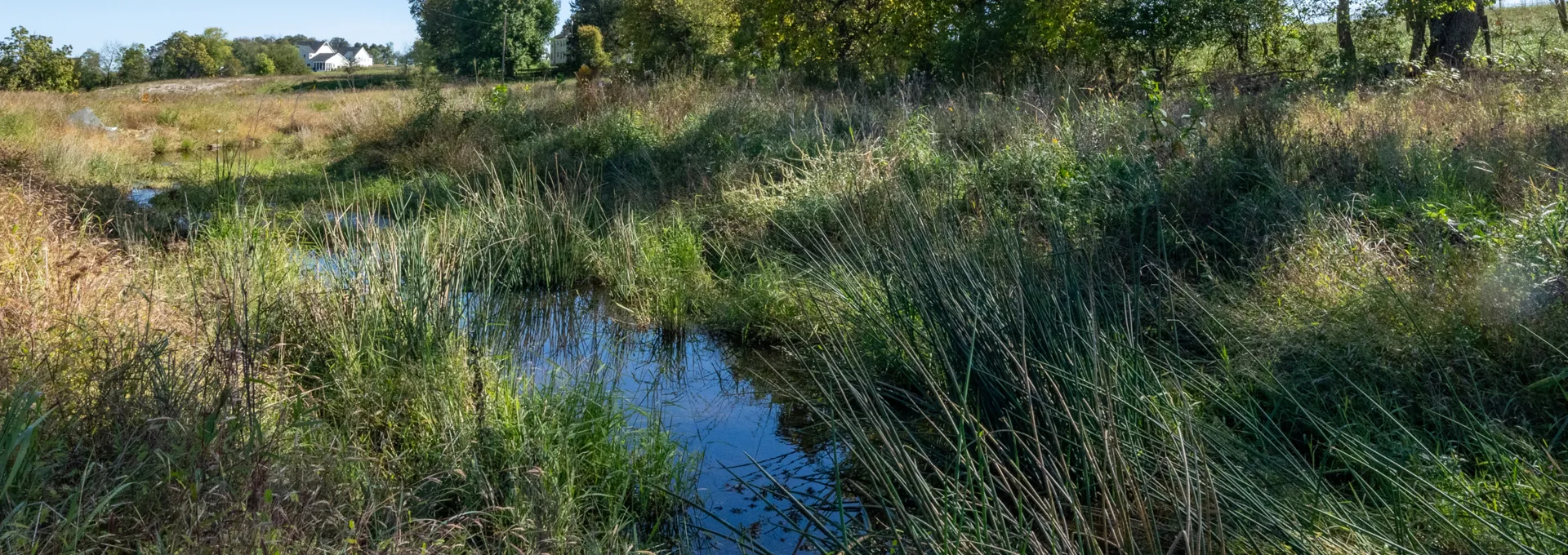
Working With Landowners
We partner with landowners to protect the valuable natural resources on their land. Together, we can unlock multiple potential revenue streams, helping owners recognize their property's equity while preserving critical habitat.
State and federal agencies often require a wide array of permits for construction projects, including when a project affects natural resources. One way to meet the permit criteria for water resources required by the agencies is mitigation.
Private property is often the best-suited land for mitigation projects. Davey Mitigation has extensive experience partnering with landowners to help protect the valuable resources on their land while enabling connections to multiple revenue streams, allowing landowners to maintain ownership and private access while becoming part of a project’s environmental stewardship.
What Does Environmental Restoration Mean For My Land?
Davey Mitigation compensates a landowner with a per-acre payment, which allows them to conduct the work and place a permanent conservation easement over the restored land. In addition to the per-acre compensation, Davey Mitigation will install and improve farm infrastructure, such as new fencing, cattle watering stations, improved farm roads, and new crossings over streams, while completing the mitigation work.
To accomplish the restoration and meet standards for environmental improvement could include a variety of construction techniques such as filling ditches and canals to restore drained wetlands, grading of floodplain areas for wetland restoration, channel relocation/re-contouring and/or stabilization of stream banks, and reseed and replant the area with native herbaceous plants and hardwood trees and natural grasses. We perform the work while ensuring your property remains profitable and productive.
Where Does The Compensation Come From?
When a land development project, such as a housing subdivision, highway widening, or other development project disturbs natural resources, state and federal agencies require mitigation to compensate for the loss of that resource as part of the permitting process. When a project meets the necessary permitting criteria, Davey Mitigation sells the credits from mitigation projects completed through conservation easements.
The Six-Step Mitigation Process
Site Walk
Contract Review
If the land has marketable potential, we provide a standard restoration and protection contract for you to review with family and other property owners.
Closing
Once a buyer is secured, we perform a detailed title search. If the property's legal status is clear, we close on the contract and assume responsibility for the easement.
Design & Engineering
Our scientists and contractors plan and design the restoration to meet the property's unique conditions, engineering it to be sustainable and compatible with future land use.
Construction & Planting
Upon receiving all necessary permits, we construct the restoration and plant appropriate native vegetation — often more than 600 trees per acre.
Monitoring & Maintenance
Davey Mitigation monitors and maintains the restoration long-term. You have no direct responsibility, beyond following the terms of the conservation easement.
Landowner FAQs
A conservation easement is a written agreement between a landowner and the State of North Carolina that protects water quality by maintaining or establishing natural vegetation in a streamside or wetland parcel or buffer. All conservation easements used for the North Carolina Ecosystem Enhancement Program (EEP) purposes are perpetual and will forever transfer with the land to maintain its integrity. The property under conservation easement cannot be used for commercial, residential or industrial development or cultivation, but instead will be kept in a natural state.
We are interested in property that could be restored to provide for the improvement of water quality as well as sites that have a high probability of success based on hydrology, soils, and vegetation. Priority is given to sites that need re-vegetation or erosion control. We are also interested in areas that have rare plants or animals, endangered aquatic species, or degraded stream.
No, the easement would only apply to the portion of land specifically identified and agreed upon between the landowner and Davey.
As a landowner, you would be compensated either through the sale of a conservation easement or through the outright sale of your land.
Mitigation sites are protected through the creation of a permanent conservation easement or environmental covenant that restricts activities that would interfere with the project’s goals and purposes. However, passive recreational activities within the easement—such as hunting, birdwatching, and fishing—are reserved for the landowner’s enjoyment.
The property can still be sold at a future date subject to the conservation easement.
With a long history serving clients, we know how to create lasting landowner partnerships and projects that stand the test of time. In fact, we’ve been involved in the science and practice of ecological restoration since its inception. We offer clients a host of mitigation solutions in a variety of markets, enabling connections to multiple potential revenue streams for our landowner partners. Our family of brands features local experts with various specialties, including professional wetland scientists, ecologists, engineers, and GIS professionals.
Featured Mitigation Projects

Dam Removal
Dam Removal & Stream Restoration In Hanover County, VA
Davey Mitigation removed a century-old dam that blocked particular fish species and endangered species from entering their native habitats.

Streams & Wetlands
Stream Restoration In Guilford County, NC
Davey Mitigation restored more than 5,700 linear feet of stream, restored over 2.5 acres of wetlands, and planted more than 12,000 native trees at the Dutch Farms Mitigation Bank in Guilford County, NC, to help stabilize the stream banks on-site and improve water quality.

Streams & Wetlands
Stream & Wetland Restoration In Alamance County, NC
Davey Mitigation restored and enhanced over 6,000 linear feet of stream channel as part of the Heron Mitigation Site.